

Developed in collaboration with a like-minded organization, the Climate Action Self-Reflection Tool is a structured capacity assessment instrument designed to empower CSOs to systematically evaluate and strengthen their ability to address climate change impacts and support community resilience. This tool brings together a comprehensive framework that assesses organizational performance across key domains relevant to climate adaptation and environmental resilience, offering cross-sectional and assessments for continuous improvement.
What is the Tool? #
The Climate Action Self-Reflection Tool is a comprehensive, theme-based questionnaire designed to guide CSOs through a rigorous process of evaluating their capacity to address climate change and build resilience. This tool covers a broad range of thematic areas essential for effective climate action, including organizational profile, mission & vision, leadership commitment, human resources and capacity, funding sources and allocation, gender and social inclusion, communication strategies, monitoring and evaluation, local context and community systems, partnerships and community engagement, and policy influence and advocacy. The tool encourages its adoption as a complementary assessment to qualitative deep dives and vice versa.
Why it Matters? #
The tool is more than a diagnostic instrument; it is a catalyst for continuous organizational development within the climate action space. It facilitates an objective rating of current organizational status against clearly defined criteria; help reveal strengths and pinpoint gaps that require attention. By standardizing the assessment process and scoring, organizations can track their progress over time. It also aids in fostering strategic clarity by linking self-reflection outcomes to informed decision-making, capacity-building priorities, and resource allocation.
Why was the Tool Developed? #
Given the increasing urgency of climate change and its localized impacts, CSOs play a pivotal role in facilitating adaptation and resilience at the community level. However, many organizations face challenges in aligning their mission, strategy, and resources with climate action priorities. This tool was developed in collaboration with ABF to address this gap by providing CSOs with a standardized and replicable method to assess their institutional capacity related to climate adaptation.
Who is it For? #
The primary users of this tool are CSOs actively engaged or seeking to engage in climate resilience activities. It is equally relevant for staff and leadership within CSOs as well as for partners and funders in enhancing understanding of organizational readiness and opportunities to scale impact through informed decision-making.
How Does the Tool Work? #
The questionnaire employs a variety of question types to capture both quantitative and qualitative information. It includes binary Yes/No questions to ascertain the presence or absence of certain policies or practices, as well as Likert-scale options that measure the degree or maturity of commitment and implementation across different areas. Some questions allow multiple selections where each option carries equal weight; the cumulative selections are then tallied to generate a score reflecting nuanced organizational capacities.
With predefined response options to evaluate capacity across organizational functions and climate-related themes. It asks whether the organization has a clearly defined climate-related mission and vision, strategic plans addressing weather impacts, leadership commitment to environmental goals, and systematic training of staff on climate risks. It also assesses whether robust metrics and monitoring exist to track progress and influence policy. Scores and responses provide a clear picture of strengths and weaknesses and suggest pathways for capacity building, strategy adjustment, and resource allocation.
What Does the Tool Bring on the Table? #
Comprehensive organizational insight: It offers CSOs a broad yet detailed view of how well their structures, policies, and practices integrate climate adaptation and community resilience objectives.
Standardized baseline and progress tracking: The tool sets a benchmark for institutional capacity, allowing repeated assessments to measure growth or emerging challenges over time.
Informed strategic planning: The assessment outcomes support evidence-based adjustments in program design, resource distribution, and partnership engagement aligned with climate goals.
Capacity building roadmap: Identifies specific knowledge gaps and training needs helping organizations equip their teams effectively.
Enhanced accountability and transparency: By documenting organizational capacity and efforts relating to climate adaptation, CSOs can communicate their readiness and impact more credibly to stakeholders and funders.
Inclusive and context-sensitive approach: It integrates gender, inclusion, and local community systems to foster equity and relevance in climate actions.
Facilitates broader collaboration and policy influence: Enables organizations to better position themselves in multi-stakeholder networks and policy advocacy based on demonstrated institutional strengths and needs.
When and Where is it Used? #
The tool is designed for flexible application by CSOs during strategic planning cycles, capacity development initiatives, or monitoring and evaluation processes. It can be used nationally, regionally, or locally depending on organizational scope, and repeated periodically to monitor progress against climate adaptation goals.
The tool is developed with expert input and can be tested in diverse contexts. It supports CSOs in building resilient, adaptive, and accountable organizations capable of effectively responding to climate challenges within their communities and sectors.
What’s New? #
Comprehensive, theme-based modules have been introduced. A self-reflection tool for CSOs is essential for systematically evaluating their capacity and performance in addressing climate action and resilience. By guiding organizations across key themes such as strategy, leadership, funding, inclusion, and community engagement, it helps uncover strengths and identify gaps.
Who Will Find the Tool Useful? #
The Climate Action Self-Reflection Tool is valuable to a broad spectrum of stakeholders in the ecosystem. It supports CSO leadership and staff in identifying institutional strengths and areas for improvement. Donors and funders can benefit from a standardized framework for assessing grantee capacities. Implementation partners can track effectiveness and guide capacity-building efforts.
Community-based organizations at the grassroots can benchmark their growth, while policymakers can use the tool to map readiness and advocate for capacity development on a scale
Demonstration: How the Scoring Systems Works Across Assessment Parameters #
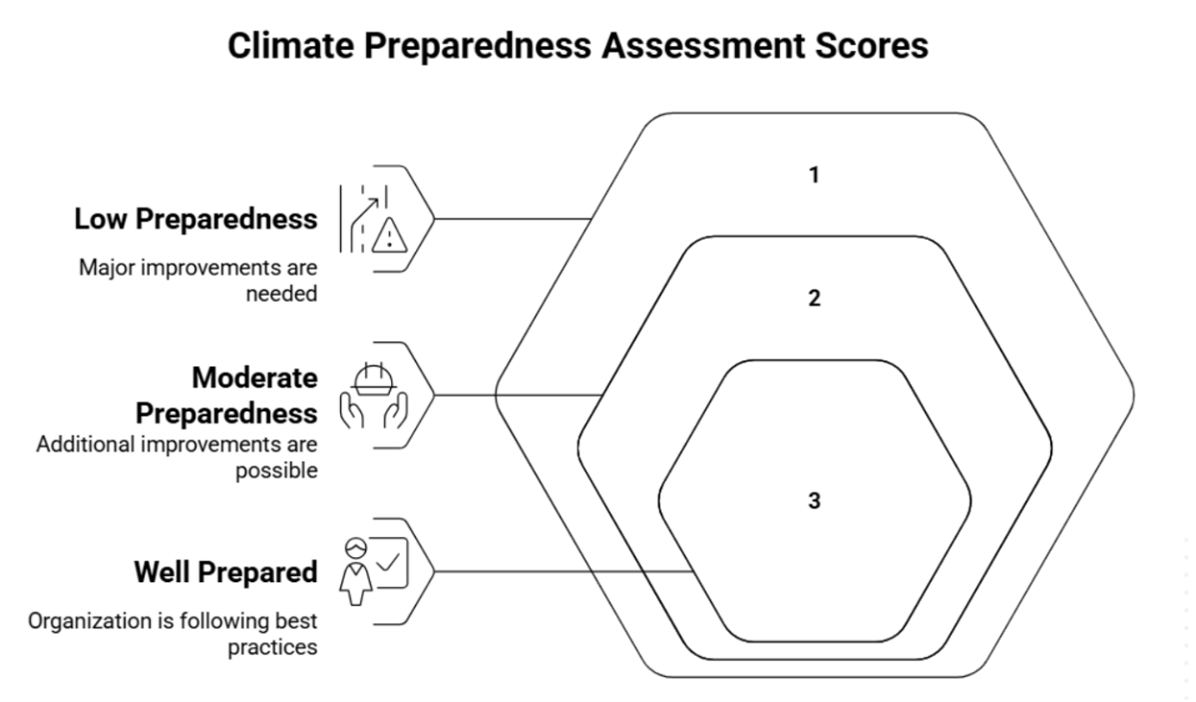
Demonstration of Scoring Tool Implementation: Non-Leading, Activity-Focused Questions Across Parameters with Scores Hidden from Respondents: #
|
S.No. |
Question | Response code |
Score |
|
1 |
How well-known is your organization’s work on reducing weather-related impacts or helping the community adapt among internal and external stakeholders?
(Awareness can be through annual reports, media coverage, joint initiatives with peer organizations, endorsements etc.) |
1=There is no awareness regarding our work on reducing weather-related impacts or helping community adapt. | 0 |
|
2=There is awareness regarding reducing weather-related impacts or helping community adapt by few key individuals from a particular department |
1 |
||
|
3=There is a fair amount of awareness regarding our work on reducing weather-related impacts or helping community adapt by internal and external stakeholders. |
2 | ||
| 4=Organization’s mandate to work on reducing weather-related impacts or helping community adapt is widely known and accepted by stakeholders. |
3 |
||
|
2 |
How well-known is your organization’s work on reducing weather-related impacts or helping the community adapt among external stakeholders?
(Awareness can be through annual reports, media coverage, joint initiatives with peer organizations, endorsements etc.) |
1=There is no awareness regarding our work on reducing weather-related impacts or helping community adapt. | 0 |
|
2=There is awareness regarding reducing weather-related impacts or helping community adapt by few key individuals. |
1 |
||
| 3=There is a fair amount of awareness regarding our work on reducing weather-related impacts or helping community adapt by external stakeholders. |
2 |
||
|
4=Organization’s mandate to work on reducing weather-related impacts or helping community adapt is widely known and accepted by external stakeholders. |
3 | ||
| 3 | To what extent do your organization’s strategic documents address weather-related impacts or/ and support community adaptation. | 1= Climate considerations are not reflected in strategic planning |
0 |
|
2= Climate adaptation and weather-related actions are mentioned but not clearly linked to the organization’s mission. The plan focuses on short-term actions |
1 | ||
| 3= The strategic document includes both short-term and medium-term actions and is partially aligned with organizational goals. Climate risks are acknowledged across multiple sectors. |
2 |
||
| 4=The strategic document is clearly aligned with the organization’s mission and vision, including short-, medium-, and long-term actions. It offers a comprehensive roadmap to reduce weather-related impacts and build adaptive capacity. |
3 |
Sonam Gupta – Deputy Manager – Research


