

Policy to Practice: Building the Foundations of Responsible AI in Indian Healthcare

Session 1: AI for healthcare in India
The second day of the India AI Impact Summit 2026 marked an important milestone toward a future-ready India. The Strategy for Artificial Intelligence in Healthcare for India (SAHI) and the Benchmarking Open Data Platform for Health AI (BODH) were launched by Shri J.P. Nadda, Hon’ble Union Minister of Health and Family Welfare and Chemicals & Fertilizers, Ms. Punya Salila Srivastava, Secretary in the Ministry of Health and Family Welfare, Dr. Sunil Kumar Barnwal (National Health Authority), Dr. Catharina Boehme (WHO-SEARO), and Prof. Manindra Agarwal (IIT Kanpur).
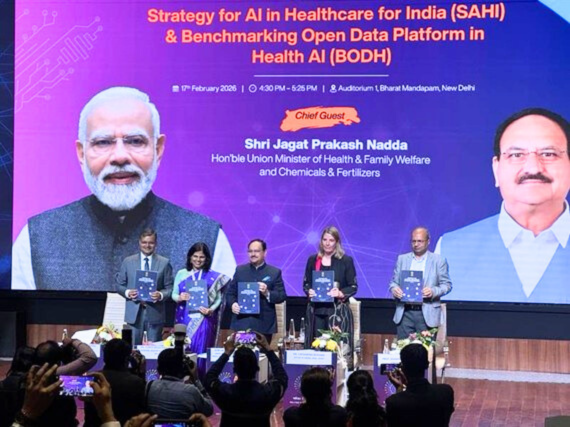
While Prof. Manindra Agarwal and Dr. Sunil Kumar Barnwal briefly described the process behind preparing the strategy document and the open data platform for healthcare AI, the Health Secretary explained how the national guidance framework would help hospitals, clinics, research institutes, and public health programs adopt AI responsibly and ethically.
Together, these initiatives represent a significant step toward a technology-ready healthcare ecosystem. They mark a strategic shift in how healthcare AI should be governed, validated, and deployed in ways that align with public trust, clinical safety, and legal accountability. SAHI is not merely a technology plan. Its core pillars include governance for development, deployment, and use; data stewardship for responsible handling of patient data and privacy; validation and monitoring to ensure safety and effectiveness; and inclusive adoption across geographies.
BODH is a technical validation platform, created collaboratively by IIT Kanpur and the National Health Authority. It aims to benchmark AI models using real-world health data without exposing underlying patient datasets. BODH is a major step toward strengthening digital public goods under the Ayushmann Bharat Digital Mission.
Together with SAHI, it will help create a balanced framework to ensure deployed AI tools are safe, reduce clinical risk, and minimize patient harm.
Session 2: Building AI Readiness and Digital Competency Among Frontline Health Workers in India
This session was led by Dr. Sampath Kumar, IAS, Health and Family Welfare, Government of Meghalaya, along with teams from the State Health Systems Resource Centre (SHSRC), Meghalaya, the Gates Foundation, Digital Health Innovations and Health Systems Research, the Johns Hopkins Bloomberg School of Public Health, the University of Cape Town, and the Johns Hopkins School of Public Health.
The workshop highlighted the importance of rapidly advancing technology for public health initiatives, while emphasizing an even more critical need: ensuring that frontline health workers, at the forefront of delivering health system initiatives to the last mile, are digitally competent rather than merely digitally literate.
The session took an interactive approach, explaining the methods used to identify the digital competencies required for different health worker roles, how these competencies can be mapped to day-to-day activities, and how the results can inform targeted capacity building, data-driven decision-making, and the strengthening of digital systems.
Isha Garg – Public Health Consultant, Sambodhi
