

PM POSHAN Yojana: A Meal, A Chance, A Future
24
Jul
Posted by: Raj Das
Category:
Education, Impact
No Comments
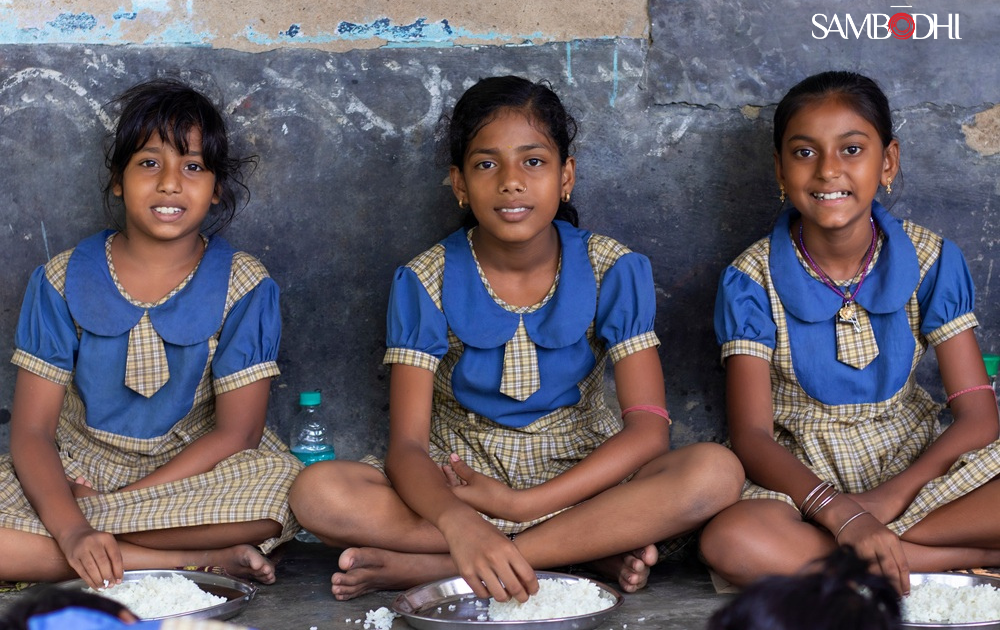
A Daily Ritual of Dignity
In a government school nestled along the dusty lanes of Palamu district in Jharkhand, nine-year-old Rajlakshmi holds her steel plate as she waits for the midday bell. That bell, for her and millions like her, is not a signal to take a break from lessons but a reminder that food is on its way. A ladle of hot rice, a watery bowl of sambar, and sometimes an egg if the kitchen stock allows. This meal is more than nourishment. It is dignity, certainty, and it is the very reason she returns to school the next morning.
More Than a Meal
The PM POSHAN Yojana, India’s national school meal program, may be recorded in policy documents as a nutritional intervention, but in practice, it is a much deeper commitment. Feeding over 11.8 crore children each school day, it remains one of the world’s largest and most ambitious social safety nets. Yet understanding its value only through the lens of scale risks missing its true meaning. A hot, cooked meal at school does not just tackle hunger; it anchors children to classrooms, encourages equality among peers, and offers families, especially those navigating food insecurity, a fragile but vital sense of support.
When it began in 1995 as the National Program of Nutritional Support to Primary Education, the initiative aimed to reduce classroom hunger and improve enrollment and attendance. By the time it was renamed PM POSHAN in 2021, it had evolved significantly. Today, it spans more than 10.24 lakh schools and engages over 25 lakh cook-cum-helpers, many of whom are women from the same marginalized communities their kitchens serve. The program has quietly embedded itself in the public school routine, acting as a foundational layer of the education system in rural and low-income geographies.
The Evidence Behind the Impact

In classrooms across India, PM POSHAN is more than a policy acronym. It is a meal that structures the day and a practice that embeds care into pedagogy. Teachers in Odisha and Chhattisgarh have observed that children, especially girls, arrive on time not because of attendance incentives but because they know lunch will be served. Multiple studies have shown that consistent access to mid-day meals significantly improves school attendance among girls in tribal districts. The correlation is intuitive, but its impact is profound. When food is dependable, school becomes more than a place of learning. It becomes a refuge.
The program yields measurable academic benefits. A study published in the Journal of Development Economics found that children who received mid-day meals throughout their primary schooling scored approximately 18% higher in reading and 9% higher in mathematics compared to peers with limited exposure to the program.
Nutrition is not a side concern in education policy. It is central to learning. And in a country where child malnutrition remains stubbornly high, PM POSHAN performs a vital preventive function.
Feeding Social Inclusion

But the scheme’s value doesn’t stop at education and health. It is also one of India’s quietest social integrators. In classrooms where children from different castes and backgrounds eat the same food from the same kitchen, discrimination loses its rigidity. Fieldwork from Bihar and Tamil Nadu suggests that over time, PM POSHAN has encouraged greater comfort among students to interact across caste lines. Of course, violations still occur. For instance, media reports from parts of Uttar Pradesh and Madhya Pradesh point to persistent caste-based exclusions, but these are now increasingly challenged, both by community members and school authorities.
Where the System Falters
Despite its achievements, PM POSHAN is not without its vulnerabilities. Supply chains are fragile. Funding delays are common. Cooks are underpaid and often overworked. A survey-based report from Arunachal Pradesh found that 74.5% of respondents agreed that the Mid-Day Meal program faces serious logistical and operational hurdles, namely, shortages of ingredients, delayed deliveries, and intermittent utility access. These failures may seem administrative, but their consequences cut through deeply. When a meal is not served, a child goes hungry. When this happens too often, the fragile bond between school and student begins to fray.
The 2021 Revamp: A Push for Nutrition Security
The 2021 relaunch of the program attempted to fix some of these bottlenecks. It included pre-primary children in eligible schools, encouraged donor-driven meals through initiatives like Tithi Bhojan, and pushed for fortification of staples with iron, folic acid, and vitamins. But implementation remains uneven.
Yet, where decentralized ownership works, the program thrives. In Odisha, women’s self-help groups under Mission Shakti run school kitchens with consistency and pride. In Tamil Nadu, robust state-level monitoring ensures that food is both nutritious and served on time. These successes underscore an important point: food security in schools is not a question of logistics alone. It is a function of institutional will, community participation, and regular oversight.
PM POSHAN also holds unexpected value beyond the classroom. It reduces the caregiving burden on mothers, especially those engaged in daily-wage work. For families navigating the informal economy, a guaranteed meal means one less worry. It also generates employment for over 2.5 million women, giving them not only income but a rare form of public legitimacy. In villages where female labor is often undervalued or hidden, the role of a school cook offers both visibility and dignity.
As India positions itself as a knowledge economy, grounded in digital transformation and global competitiveness, it would be a mistake to view school meals as charity or legacy welfare. PM POSHAN is not ancillary to development. It is its bedrock. No nation can educate or skill its population at scale if its children arrive at school hungry. No innovation can take root in classrooms where nutrition is erratic. The meal, simple as it is, makes everything else possible.
Where Hunger Ends, Learning Begins

In the end, the success of PM POSHAN is not measured only in calories or enrollment figures. It is measured in the quiet assurance on a child’s face when the lunch bell rings, in the routine confidence of a mother who knows her daughter will eat that day, in the pride of a cook who serves her community with more than just food. It is measured in millions of lives held gently but firmly in the grasp of a public program that works not through spectacle but through the constant commitment of care.
And for Rajlakshmi and children like her, that commitment is not an abstract policy win. It is lunch. It is the future. It is hope ladled gently into a plate.
References
PM POSHAN, Ministry of Education, Government of India, https://pmposhan.education.gov.in/aboutus.
“PM POSHAN Telangana”. PM POSHAN, Ministry of Education, Government of India, https://pmposhan.education.gov.in/Files/PAB/PAB-2017-18/Telangana/1_WRITE%20UP%20-%202017-18%20%20(CORRECTED).pdf
“Mid-Day Meal (PM POSHAN) Scheme Is Being Implemented in 10.24 Lakh Government and Government-Aided Schools.” Press Information Bureau, Government of India, 19 Mar. 2024, https://www.pib.gov.in/PressReleaseIframePage.aspx?PRID=2082529#:~:text=10.24%20lakh%20Government%20and%20Government%2Daided%20schools%20on%20all%20school%2Ddays.
“About Mid-Day Meal.” PM POSHAN Automated Monitoring System, Ministry of Education, Government of India, https://pmposhan-ams.education.gov.in/About_mdm.aspx#:~:text=More%20than%2025.70%20lakhs%20cook%2Dcum%2Dhelper%20are%20engaged%20by%20the%20State/UTs.
“Mid-Day Meal Scheme: Final Report – Chhattisgarh.” Mid-Day Meal Programme, Government of Chhattisgarh, https://mdm.cg.nic.in/Downloads/MDMChattisgarhFinalReport.pdf.
Singh, Abhijeet, and Faezeh Foroutan. “Impact of a National School Feeding Program on Education and Nutrition: Evidence from India.” Journal of Public Economics, vol. 172, 2019, pp. 1–18. ScienceDirect, https://www.sciencedirect.com/science/article/abs/pii/S0304387818305145
Chakraborty, Tanika, and Rajarshi Jayaraman. “School Feeding and Learning Achievement: Evidence from India’s Midday Meal Program.” Journal of Development Economics, vol. 139, 2019, pp. 249–265. ScienceDirect, https://www.sciencedirect.com/science/article/abs/pii/S0304387818305145.
Kurbah, Daphisha. “A Study on the Challenges of Mid-Day Meal in Arunachal Pradesh with Special References to Namsai District.” Alochana Journal, vol. 13, no. 2, 2024, pp. 1–5. https://alochana.org/wp-content/uploads/21-AJ2076.pdf.
Raj Kashyap Das –Knowledge & Insights Coordinator, Sambodhi
