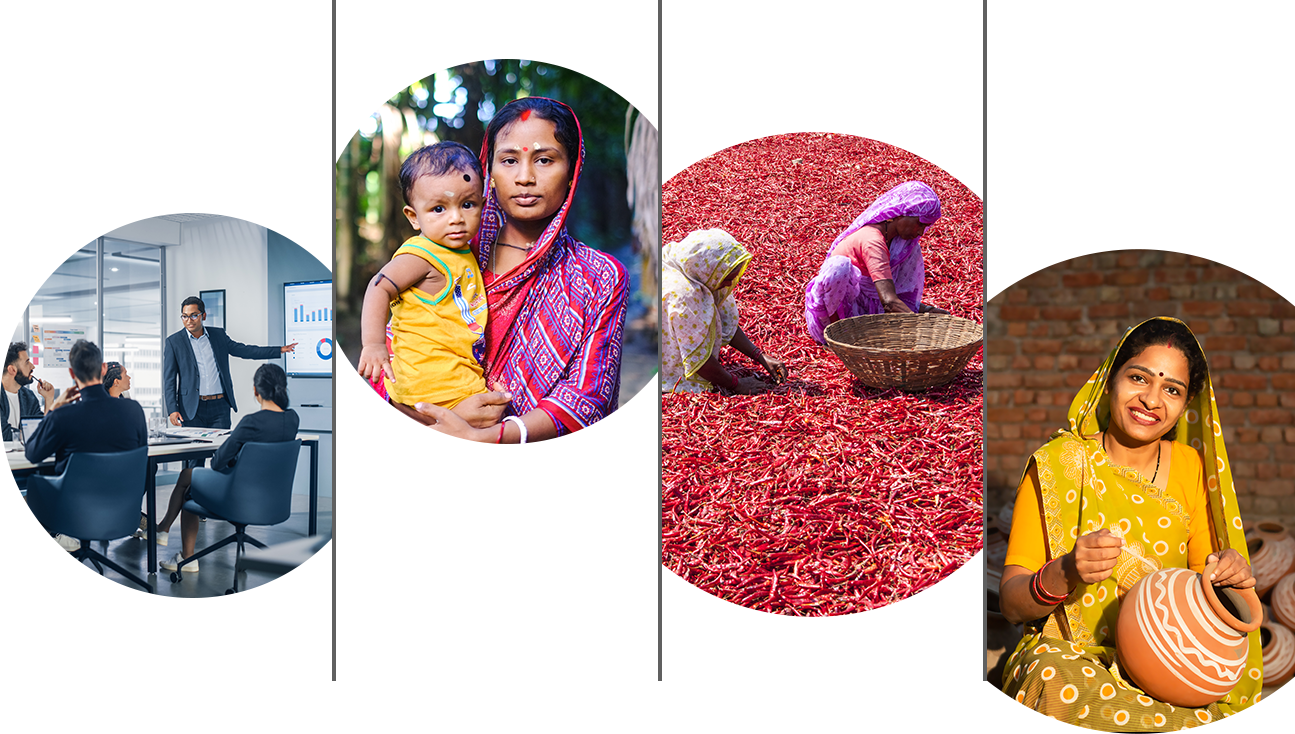


Strengthening Health Systems
Through Evidence, Innovation,
And Digital Transformation
Health systems are constantly evolving to shifting population needs, emerging priorities, and the pace of technological change, all while working toward ambitious national development goals.
As programs grow more integrated and data-driven, the capacity to generate timely evidence, strengthen implementation on the ground, and sustain a culture of continuous learning has become central to improving health outcomes.
Our work draws on several interconnected areas of practice, spanning research, measurement, systems, technology, behavior, and policy, each shaped by direct experience solving problems inside real health systems.

1. Health systems research
2. Implementation research
3. Mixed-methods evaluations
4. Landscape and diagnostic
assessments
5. Rapid evidence synthesis

1. Health systems diagnostics
2. Quality improvement
3. Technical assistance
4. Institutional and workforce capacity
strengthening
5. Governance and programme
management support

1. Social and behaviour change (SBC)
2. Community engagement
3. Human-centred research
4. Behavioural insights

1. Monitoring, evaluation, and learning (MEL)
2. Impact, process, and outcome evaluations
3. Adaptive learning systems
4. Results measurement and performance
monitoring

1. Digital health readiness assessments
2. AI for public health
3. Health information systems
4. Data analytics and decision-support
tools

1. Programme design
2. Policy research
3. Strategic advisory
4. Knowledge translation

Our expertise is underpinned by the conviction that health systems perform best when they are guided by sound evidence and structured to close the persistent gap between what is known and what is done, extending the reach of quality health outcomes to every population, in every context. Delivering on this conviction depends less on what we know than on how we work, and it is here that three commitments define our engagements.

End-to-End Engagement
We support institutions across the full lifecycle of a program, from formative research and landscape assessment through design and implementation to sustainability planning, recognising that fragmented engagement undermines the very outcomes it is meant to serve.
Technical Depth
Our team draws on epidemiology, the social sciences, biostatistics, and advanced data analytics, applying a level of methodological rigor to engagements that are too often under-resourced on precisely this dimension.
A Bias Toward Action
We regard data and findings as a point of departure rather than a conclusion, translating them into strategies capable of informing policy decisions, shaping institutional practice, and producing outcomes that can be measured and held to account.
We work alongside governments, multilateral agencies, philanthropic foundations, academic institutions, and implementing partners, each navigating its own constraints, from limited implementation capacity and fragmented data systems to competing accountability demands and the pressure to show results at scale.
Rather than applying a single model across every context, we adapt our engagement to where each partner sits in the continuum of public health work, from research and program design through implementation support, monitoring, and evaluation, so that the support we provide matches the reality each institution is operating within.
nimbli.ai is Sambodhi’s impact management platform that brings your entire evidence journey under one roof.It covers everything from data collection and monitoring to analysis, reporting and stakeholder communication.
It is the one place to generate, manage and act on evidence, built for teams who want complete clarity at every stage of the programme lifecycle.