
Monitoring and Evaluation Course for Development Professionals
Advance your career with our Monitoring and Evaluation Course, a five-month online certificate program. Designed for professionals in India and the Global South, this is one of the best monitoring and evaluation courses for building practical skills in evidence-based program development and policy. It’s the perfect project management course complement for those aiming to lead robust MEL systems and drive meaningful impact.
New batch starting in October 2026
Weekend Batch, 11.00 am – 2.00 pm IST
Reach out to us at: +91 9289201141
Offered By

Course Structure
Course Details
As the eight-year countdown to achieving the 2030 SDGs begins, there has been a strong impetus toward improving developmental outcomes and strengthening Monitoring, Evaluation, and Learning (MEL) systems at organizational and national levels. Despite the depth of MEL expertise and extent of practice within the Global South, there have been very few practitioner-driven, knowledge exchange spaces which can facilitate perspective building and enhance the knowledge and skills of early and mid-career development professionals located in the global south. With this in mind, Sambodhi is offering an online certificate course: Monitoring, Evaluation, and Learning for Development Professionals (MEL4DP).
- Provide conceptual clarity on MEL through a practitioner’s lens.
- Equip participants with the knowledge and practical skills to plan, conduct, and manage effective M&E of programs to facilitate continuous learning and program improvement.
- Contextualize the application of existing MEL frameworks and approaches by drawing from case studies and examples from the global south.
- Build critical perspectives on various aspects of MEL practice and theory,
- Foster cross-sectoral and cross-disciplinary dialogues by using examples from different sectors and theories that have emerged from different disciplines.
- Create a space for peer-learning, collective thinking, and networking for early-career development professionals.
- Practitioners’ lens: developed and facilitated by MEL practitioners & experts, for practitioners.
- Multi-sectoral perspective: uses case studies & real-world examples from different sectors
- Real-world examples: application-based interactive learning through classroom activities
- Context specific: builds critical perspective for the global south
- Merit-cum-means scholarship: scholarships and discounts offer available
- Mixed method approach: uses hands on tools and approaches from quantitative and qualitative perspective.
- Weekend learning for working professionals: tailored for early and mid career professionals with weekend classes
- Differentiate between Monitoring, Evaluation, and Learning, and gain a nuanced understanding of MEL vocabulary, contextualize MEL in Program Cycles, and define pathways of change using Theory of Change approaches,
- Gain an understanding of different monitoring typologies, use publicly available datasets for monitoring, and construct interactive monitoring dashboards,
- Define and utilize different evaluation approaches, frameworks, and designs and Keep pace with contemporary trends in evaluations,
- Practically implement an evaluation by developing an understanding of Evaluation Cycles, Implementation, Designs, Methods, and Tools, and
- Harvest learnings from evaluations, and utilize them for continuous program improvement.
Modular learning outcomes:
Course Outline
The program comprises of eight comprehensive modules, emphasizing on a blend of theory and practical application, ensuring that learners are equipped to effectively leverage data for program improvement and decision-making in the development sector. Each module is designed to enhance skills, foster critical thinking, and promote effective communication of evaluation findings, preparing participants to drive impactful change within their organizations.
Duration: 1 Week
Introduction: The first module introduces participants to the essential concepts of Monitoring, Evaluation, and Learning (MEL) in development programs. It highlights the evolution of evaluation, the significance of the Global South perspective, and the role of data in shaping policies and program design. This module sets the stage for understanding MEL’s impact on decision-making and program effectiveness.
Topics:
- Distinguishing MEL Concepts
- Data’s Role in MEL and Policy
- Evolution of MEL in the Global South
Duration: 1 Week
Introduction: This module provides an in-depth overview of key Monitoring, Evaluation, and Learning (MEL) frameworks, including Logical Frameworks, Results-Based Management, and Theory of Change. Participants will explore how MEL fits within the project cycle and gain a solid understanding of core MEL terminology. Through practical examples and group work, this module equips learners to critically apply these frameworks to address developmental challenges and enhance program evaluation.
Topics:
- Introduction to Monitoring Frameworks
- Key MEL Terms and Types
- Frameworks in Development Practice
Duration: 1 Week
Introduction: This module introduces participants to the use of public datasets for program monitoring and evaluation, focusing on the role of administrative and public intent data. Participants will explore how these datasets, combined with dashboards, can be leveraged for tracking program outcomes, monitoring key indicators, and conducting impact evaluations. With practical examples and hands-on activities, the module equips participants with the skills to develop real-time monitoring systems and create data-driven reports using public datasets.
Topics:
- Public Datasets for Monitoring
- Concurrent Monitoring Plans
- Building Monitoring Dashboards
Duration: 1 Week
Introduction: This module delves into the complex socio-cultural and power dynamics that influence Monitoring and Evaluation (M&E) practices. It explores how stakeholder groups are shaped by these contexts and the importance of incorporating gender, equity, and intersectionality perspectives into evaluation cycles. Participants will learn to design gender-responsive evaluations, develop inclusive frameworks, and apply equity-driven approaches, ensuring that M&E practices are both contextually relevant and socially conscious.
Topics:
- Power and Socio-Cultural Influences on M&E
- Gender, Equity, and Intersectionality in M&E
- Engendering an Inclusive Evaluation Cycle
Duration: 1 Week
Introduction: This module provides a comprehensive overview of various evaluation approaches and frameworks, enabling participants to understand their application in different contexts. Emphasizing the development of evaluation questions, participants will learn to differentiate between methods, approaches, designs, and frameworks. The module also explores key evaluation criteria, including the OECD-DAC framework, while comparing its strengths and limitations with other evaluation approaches such as Theory-Based, Participatory, and Realist Evaluation. Through this module, learners will gain insights into how to select the most appropriate evaluation approach based on specific program needs and objectives.
Topics:
- Crafting Evaluation Questions
- Methods vs. Approaches in Evaluation
- OECD-DAC Criteria and Comparisons
Duration: 2 Weeks
Introduction: This module focuses on equipping participants with the knowledge and skills to understand and apply various research designs in evaluation contexts. Participants will explore the necessity of different research designs, including causal (experimental and quasi-experimental), descriptive (cross-sectional and longitudinal), and non-experimental approaches. The module also emphasizes practical applications through group work, fostering collaboration and critical thinking in the design and execution of research studies. Additionally, an introduction to qualitative research will provide a comprehensive understanding of how qualitative methods and thematic analysis complement quantitative evaluation efforts
Topics:
- Understanding Evaluation Designs
- Causal and Descriptive Research Designs
- Introduction to Qualitative Methods
Duration: 4 Weeks
Introduction: This module provides a comprehensive exploration of the critical components of evaluation practice. Participants will learn about various research designs, data collection methods, and the principles of effective questionnaire design. Emphasizing both qualitative and quantitative approaches, the module covers sampling techniques and descriptive statistics, alongside the ethical considerations necessary for responsible data collection. Through group exercises and practical applications, learners will gain hands-on experience in using statistical software like SPSS and STATA, enhancing their analytical skills for data-driven decision-making.
Topics:
- Designing Effective Questionnaires
- Sampling Techniques and Statistics
- Data Ethics and Software Tools (SPSS, STATA)
Duration: 2 Weeks
Introduction: This module serves as a capstone for the course, emphasizing the critical role of learning in Monitoring, Evaluation, and Learning (MEL) practices. Participants will explore how evaluation insights can drive program improvement and inform actionable recommendations. The module also covers effective reporting and communication strategies to ensure evaluation findings reach relevant stakeholders, including project participants. Through this module, learners will develop the skills necessary to optimize learning and facilitate the dissemination of evaluation results, fostering a culture of continuous improvement within their organizations.
Topics:
- Actionable Recommendations from Evaluations
- M&E for Program Improvement
- Effective Reporting and Communication
Course Fee
800 USD
Partial scholarships will be available to some candidates
Discounts on course fee in case of institutional sponsorships & participants from grassroot organizations
New batch starting in October 2026
Weekend Batch, 11.00 am – 2.00 pm IST
Total Seats: 50
Enquiry Now
Testimonials

Abhinav PandeyAssociate Sector Lead- HCL Foundation
This training course is beyond my expectations. These tools and methodology & principles have opened my eyes to how to be effective and ethical! Honestly speaking I wanted to be a Researcher but, due to a lack of knowledge and guidance it was difficult for me (I was thinking) but, after attending the course I really found the path that how I have to initiate. Thanks, Sambodhi, and their amazing teacher/ trainer(s). Looking forward to putting all those learning things into my professional and personal practices. Thanks again!

Hashir P.VCentre for Research in Schemes and Policies
MEL4DP Program has immensely helped me in getting clarity on MEL through a clear practical lens. The course taught me various aspects of MEL practice and theory and dashboard making by drawing examples from different case studies. I strongly recommend this course to beginner and mid-level professionals interested in monitoring and evaluation. A big thank you to Sambodhi and my mentors for providing me with a scholarship to pursue this course.

AbhaSenior Research Manager- Sambodhi
I have been a development practitioner for six years. I, however, felt the need to understand the “change” that was coming from the immense work we all were doing. I switched my career to M&E in sambodhi. We were offered a course that was so deep yet easy to understand the gist, which was bliss to a professional like me from the field. Right from the history of monitoring and evaluation to all the techniques and technicalities, this course is a complete package for any professional wanting to get into the domain of M&E. This course also offers some learning while doing which is great and easy to cope with regular office work.

Peter MazediMinistry of Agriculture and Food security South Sudan
It was my pleasure to be enrolled in this course. This is the first professional training conducted on M&E after my graduation in Economics. I was assigned to the unit of M&E but was interested in getting professional training to perform my duty well. I was just Googling for M&E materials, then I came across your brochure. I was skeptical because I thought the call for application was a scam, but later on I applied. Now I am really happy with my decision because I have gained concepts and practical skills in M&E which I am using for my professional growth.

Petronella MagadzireSocial scientist
I highly recommend the MEL4DP course as it provides a great learning experience. The case studies and group sessions also allow one to view MEL issues from various points of view and facilitate networking.

Ugyen Samdrup LhamoProgram, Bhutan Center for Media & Democracy, Civil Society Organisations
The diverse experts from the field and the hands-on activity in this course makes this a comprehensive course perfect for aspiring professionals to learn more about MEL and use it to strengthen evidence-based decision making for their programmes/projects. The SAMBODHI team also ensures a conducive learning environment through continuous support provided to all participants.

Victor KakogbeInformation Management/Reporting, Catholic Caritas Foundation of Nigeria
The MEL4DP is a comprehensive course that exceeded all my expectations as far as MEL is concerned. Its unique selling point is that it offers practical, hands-on skills development on the subject from experienced professionals, which is a pleasant deviation from the theory-based teaching obtained from conventional educational institutions. The content of the course is so rich and condensed such that if stretched will require over a year to cover. As an Information Management and Reporting Officer with Caritas Nigeria, working in partnership with UNHCR to provide Protection Services to Cameroonian Refugees, the course significantly strengthened my professional capacities. In late December 2023, I applied the acquired knowledge during a multi-functional team assessment of a displaced population, where the MEL skills proved immediately relevant and invaluable. I have only just begun to scratch the surface of the knowledge acquired. The course experience was intense, challenging, and exhilarating—balancing demanding schedules with the excitement of learning alongside professionals from diverse cultures, regions, and continents. The shared perspectives and experiences were transformative, providing nuanced insights that have already begun to reshape my approach to monitoring, evaluation, and learning in humanitarian work.

Manik SharanResearch Associate, KSG India
As an individual interested in society’s betterment through social welfare measures & sustainable development interventions, and an aspiring development practitioner attempting to take cognizance of the impact of such interventions, I could not have asked for a better introduction to the world of M&E than the one provided by MEL4DP Program. I was impressed by the logical design of the program which delineated the overarching framework through clear and precise modules, allowing sessions to flow sequentially and seamlessly from one topic to another, in a time bound manner. Another highlight included the Program, through its facilitators, adopting a judicious mix of theoretical underpinnings and technical learnings which ensured a comprehensive coverage of the field of M&E. Deeply appreciative of Sambodhi for curating a course which is tailored to suit the needs and schedules of both beginner and mid-level professionals, making us better development practitioners.

Sudipta Ranjan RamM&E Specialist, CBM India Trust, Bangalore
I would like to thank Sambodhi for designing the training course so meaningful and critical for Monitoring, Evaluation and Learning which is contributing a lot in my career. As a development professional, this program has provided new insights into methodologies that were previously underutilized. Each module is thoughtfully prepared and relevant, specifically modules like monitoring for programs, evaluation approaches and frameworks, quantitative data collection and analysis along with the storytelling and visualization components being particularly impactful. I would like to use these concepts in my organization which can add value and skill to what I am doing currently. Being an M&E Specialist in the organization, I can provide bigger support to the organization producing quality data and information for quality program delivery and informed decision-making. The course was not only interesting but also led by incredibly skilled and knowledgeable instructors who created an environment that encouraged critical thinking and analysis. This training has significantly enhanced my professional capabilities and will undoubtedly add tremendous value to my current role and future endeavours in development work.

Dr Hastings Olole BaridakaraMedical Doctor, International Medical Corps(IMC) Nigeria
The MEL4DP program at Sambodhi was a transformative five-month journey that comprehensively enhanced my understanding of MEL concepts. The course masterfully blended theoretical knowledge with real-world case studies, creating an engaging and highly relevant learning experience. Expert facilitators provided invaluable guidance, fostering an interactive and collaborative learning environment. Through engaging discussions and expert-led sessions, I developed critical skills in data collection, interpretation, and analytical thinking. The interactive classroom environment, enriched by real-world case studies and discussions with experienced professionals, provided profound insights into MEL practices across development sectors. I am confident that the skills and knowledge I have gained from this program will greatly benefit my future endeavours in the development sector. It has been an invaluable investment in my professional growth, and I highly recommend it to anyone seeking to make a meaningful impact in the field.

Anand PathanjaliPartnerships and Campaigns Manager, Power for All
This course was definitely an eye-opener into the MEL landscape. I have been working in the sector for the last 11 years in the environment and clean energy NGO space. I wanted to upskill myself in the MEL space but wanted something more comprehensive and something that I can commit myself to. The course provided me with a comprehensive understanding of various MEL concepts and different schools of thought. Through interactive sessions, I gained valuable insights by engaging with peers and instructors, learning from real-world examples and case studies that enriched my understanding of MEL methodologies. It also motivated me to take more MEL roles in the role I am currently in and gained confidence to look out for jobs that are more MEL oriented
Certificate Course:
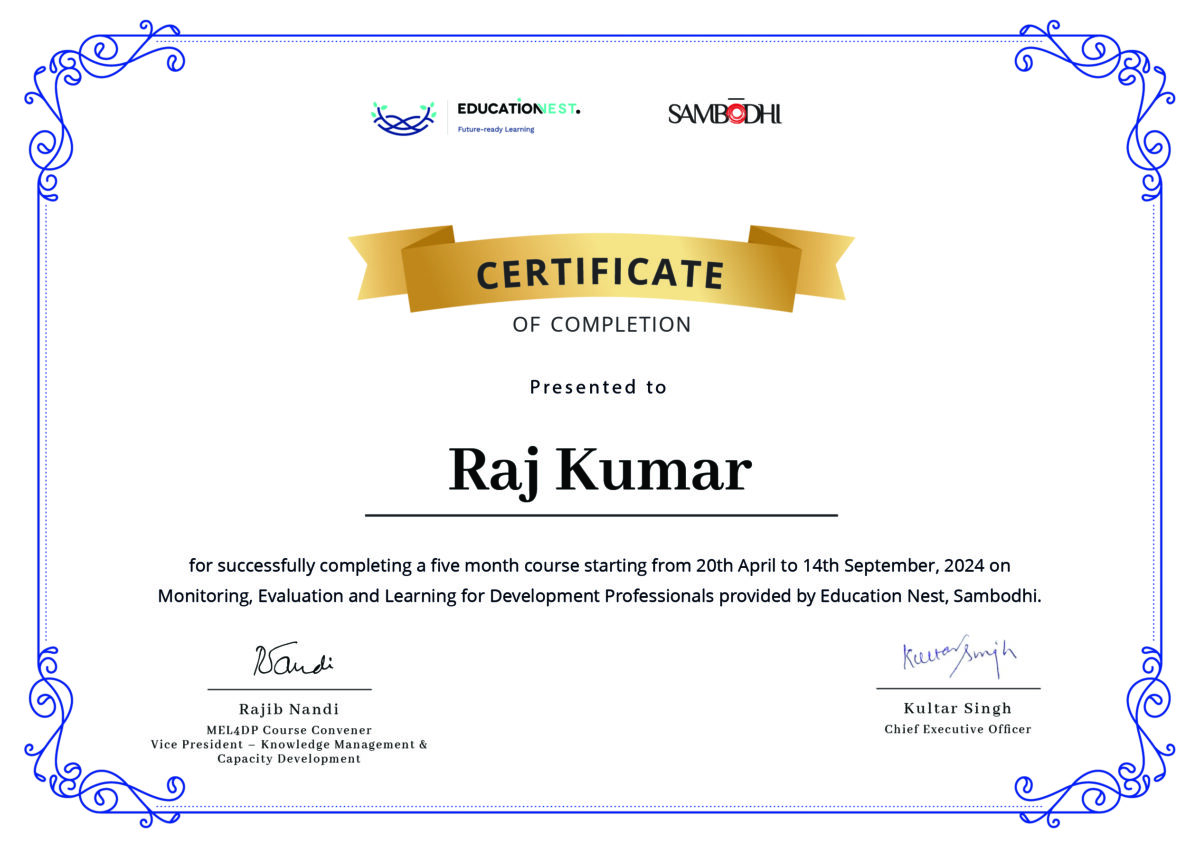
Upon completion of course modules and capstone, students will be awarded a course completion certificate
Course Facilitators


Tathagata Dasgupta
Expertise: Rural Development, Health, Nutrition, Water and Sanitation
Tathagata, a Senior Consultant at Sambodhi Capacity and Learning Institute, has 28 years of expertise in development research and monitoring, leading over 200 large-scale projects across health, nutrition, and rural development. He was also a visiting Faculty in North Point University (India Counterpart)

Vikas Choudhry
Expertise: Epidemiology, health systems, sexual and reproductive health of youth
Vikas is a social epidemiologist with over 10 years of expertise in strengthening health systems and youth-focused reproductive health, promoting sexual and reproductive health, and the rights of young people.

Shikha Rana
Expertise: Maternal health, social norms, women’s empowerment, nutrition, WASH, social impact studies, and coalition building.
Shikha is a social impact researcher with over eight years of expertise in maternal health, social norms, women’s empowerment, nutrition, and WASH. She excels in data-driven decision-making and coalition building in global development

Pooja Pandey
Expertise: Education, Child rights, inclusion, policy engagement, capacity building, and advocacy.
Pooja is a researcher cum practitioner with six years of experience in education, child rights and governance. Her expertise includes mixed-methods research, policy engagement, capacity building, and advocacy on education policy issues

Anuradha Katyal
Expertise: Health systems, impact evaluation, primary care, urban health, health service delivery, and knowledge management.
Anuradha is a public health professional and quantitative researcher with over 14 years’ expertise in health systems research, health financing, impact evaluation, primary care, and urban health. She holds advanced degrees in healthcare management and data science and is passionate about leveraging national surveys for policy impact.