Certificate Course in Data, Impact and Policy
The Certificate Course in Data, Impact, and Policy for Development Professionals is a comprehensive program designed to equip you with the skills and knowledge necessary to harness the power of data for informed decision-making. Learn to collect, analyze, and interpret data to drive policy changes, measure impact, and optimize development programs. Enhance your career prospects and contribute to sustainable development with this expert-led certification course.
Acquire in-demand skills in data analysis, visualization, and storytelling. Gain hands-on experience with tools like Excel, Tableau, and Power BI. Join a community of like-minded professionals and experts in the field. Transform your career and make a lasting impact in development.
Reach out to us at: +91 9717300804
Get in Touch
About the course
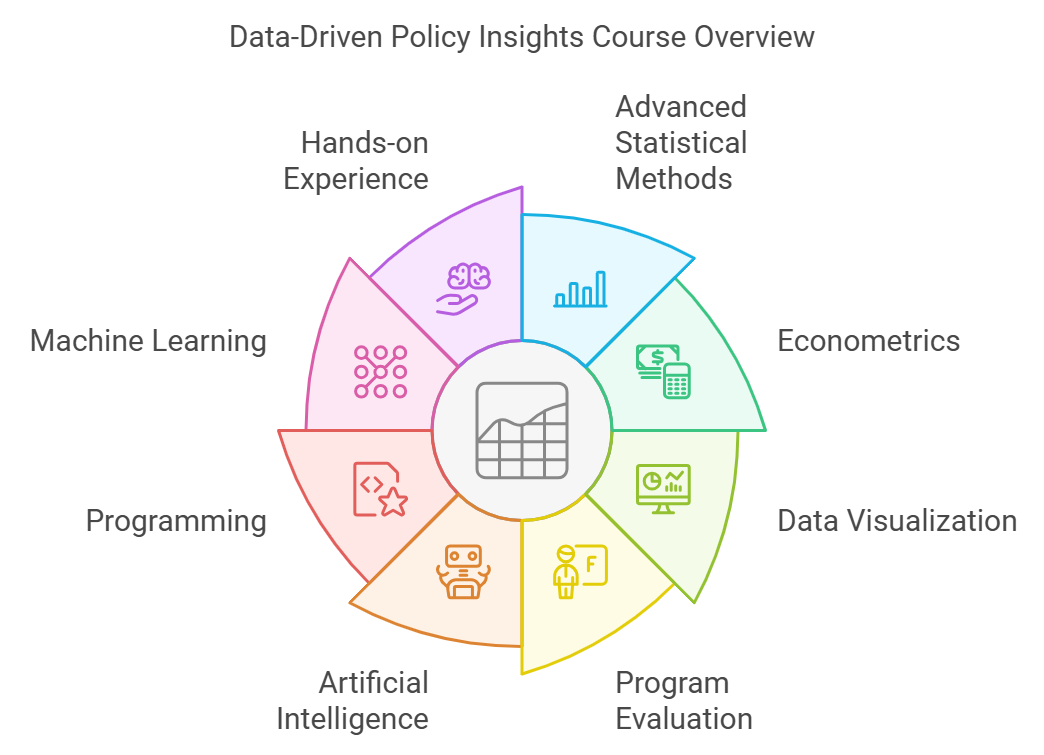
This course equips participants with the analytical skills and knowledge needed to interpret and leverage data, transforming complex datasets into actionable insights. The curriculum covers essential areas such as advanced statistical methods, econometrics, data visualization, and program evaluation, equipping participants with the tools to address contemporary policy issues with precision and confidence.
While the course introduces participants to Artificial Intelligence, programming and machine learning techniques also, it is designed to provide a foundational understanding rather than an exhaustive mastery, ensuring a realistic and achievable learning curve within the 16-week duration. By the end of the course, participants will be adept at translating data into actionable policy insights and effectively communicating their findings to diverse stakeholders.
Participants will gain hands-on experience with industry-standard tools and methodologies, making them proficient in handling large datasets and creating data-informed policies and recommendations. The course’s comprehensive approach, combining theoretical foundations with practical applications, sets it apart from other programs, providing unmatched value to its attendees. By the end of the course, participants will be equipped to drive impactful policy decisions and effectively communicate their data-driven insights to diverse stakeholders.
Course Details
- Practitioners’ lens: Developed and facilitated by industry experts and seasoned practitioners.
- Multi-sectoral perspectives: Uses frameworks, case studies, real-world examples, and data sets from different sectors.
- Weekend learning for working professionals: Tailored for early to mid-career policy professionals with weekend classes.
- The total course duration is 16 weeks, divided into 6 comprehensive modules. Each module spans approximately 2-4 weeks, consisting of instructor-led sessions, core readings, and assignments. There will be a week-long term break for participants to catchup on the materials covered till mid-term.
- To accommodate the busy schedules of working professionals, online sessions of 3 hours will be conducted on Tuesdays from 5 – 8 PM.
Upon completion of the DIP4DP program, the participants will:
- Gain a well-rounded skill set that combines technical proficiency in data analytics with a deep understanding of public policy and social impact contexts.
- Master and apply advanced statistical and analytic methods relevant for addressing policy challenges.
- Learn to interpret data and translate complex analytical findings into clear, actionable insights for the policymakers and stakeholders to understand.
- Learn how to use data analytics to formulate well-grounded policy recommendations that address current policy and development challenges
Last date to apply
Sunday, 5th January 2025
Cohort begins
Tuesday, 7th January 2025
Early bird applications
Tuesday, 31th December 2024
Level of effort
To ensure successful completion of the course, participants should allocate approximately 8-10 hours per week. This includes 3 hours of instructor-led online sessions and around 5-7 hours for self-study and assignments. The course is structured to be intensive yet manageable, recognizing that every participant has their own pace of learning. This estimate serves as a general guideline to help with time management over the 16 - week duration.
Core modules
The program is structured into six comprehensive modules, each designed to equip participants with the necessary skills and knowledge to leverage data in public policy effectively. Each module combines theoretical foundations with practical applications, ensuring a well-rounded learning experience.
Duration: 2 weeks
Introduction: This foundational module introduces participants to the essential concepts and techniques in data management and analysis. It sets the groundwork for subsequent modules by ensuring a solid understanding of data types, sources, and handling methods.
Topics:
Introduction to data concepts
Duration: 2 hrs | Date: 7th Jan 2025
Types of data: qualitative vs. quantitative
Data sources: surveys, administrative data, open data
Data ethics and privacy considerations
Data management & data handling techniques
Duration: 2 hrs | Date: 15th Jan 2025
Data cleaning and preprocessing techniques
Data storage and retrieval
Data transformation and cleaning using Excel
Handling missing data
Working with public datasets
Duration: 2 weeks
Introduction: This module focuses on the statistical methods crucial for analyzing data in public policy contexts. Participants will learn to use both descriptive and inferential statistics to draw meaningful insights from data.
Topics:
Descriptive statistics & introduction to theory of probability
Duration: 3 hrs | Date: 22nd Jan 2025
Measures of central tendency (mean, median, mode)
Measures of variability (range, variance, standard deviation)
Probability theory and distributions
Data visualization (histograms, bar charts, scatter plots)
Inferential statistics & univariate & bivariate analysis
Duration: 3 hrs | Date: 28th Jan 2025
Hypothesis testing (t-tests, chi-square tests)
Confidence intervals
Correlation and causation
Simple linear regression
Cross-tabulation and chi-square tests
Duration: 2 weeks
Introduction: Building on the basics of statistics, this module delves into more complex statistical models. Participants will learn to use multivariate analyses and understand advanced techniques for analyzing policy data.
Topics:
Multivariate analyses
Duration: 3 hrs | Date: 4th Feb 2025
Multiple regression analysis
Logistic regression
Data reduction techniques – Factor analysis
Applications of PCA in policy analysis & indexing
Time series analysis & using AI techniques for advanced data analysis
Duration: 3 hrs | Date: 11th Feb 2025
Introduction to time series data
Forecasting models (ARIMA)
Applications in policy forecasting
Introduction to Data Analysis using AI techniques – Claude & Zoho analytics
TERM BREAK – 18th February
Duration: 4 weeks
Introduction: This module equips participants with the skills to evaluate policy interventions. It covers various causal inference methodologies and their application in real-world scenarios.
Topics:
Quantitative evaluation design
Duration: 3 hrs | Date: 25th Feb 2025
What is a research design?
Why different research designs are needed?
Descriptive Designs – Cross Section and Longitudinal
Causal – Experimental and quasi-experimental
Non-experimental design
Qualitative evaluation design
Duration: 3 hrs | Date: 4th Mar 2025
Introduction to Qualitative Research
Qualitative Methods
Qualitative Designs
Thematic Analysis
Thematic Analysis Using AI
Doing Evaluation: Data collection, methods, sampling & analytics and data collection ethics
Duration: 3 hrs | Date: 11th Mar 2025
What is a Questionnaire?
Stages of Questionnaire Design
Types of questionnaires: open and closed ended
Wording and layout of questionnaires
Piloting and pretesting
Data collection methods
Qualitative questionnaires
Developing questionnaires using Google Form
Theory and practice of sampling
Duration: 3 hrs | Date: 18th Mar 2025
Key Terminologies – Population, Sampling
Census Vs sample
The sampling design process
Probability and non-probability sampling
Factors determining sample size
How to decide a sample size?
Duration: 3 weeks
Introduction: This module introduces participants to the basics of programming and machine learning. It provides a foundational understanding of how these tools can be applied to public policy.
Topics:
Introduction to programming
Duration: 3 hrs | Date: 25th Mar 2025
Basics of Python and R
Data manipulation with Pandas (Python) and Dplyr (R)
Machine learning techniques
Duration: 3 hrs | Date: 1st Apr 2025
Supervised learning: Classification and Regression Trees (CART)
Unsupervised learning: Clustering and dimensionality reduction
Applications in policy evaluation and impact measurement
Duration: 3 hrs | Date: 8th Apr 2025
Predictive modelling for policy decisions
Case studies on machine learning in policy analysis
Duration: 1 week
Introduction: The final module focuses on how to effectively communicate data-driven insights. Participants will learn data visualization techniques and how to craft compelling narratives for policy audiences.
Topics:
Crafting policy narratives & effective comm strategies
Duration: 3 hrs | Date: 15th Apr 2025
Writing policy briefs and memos
Developing compelling op-eds
Tailoring messages for different audiences
Presenting data-driven insights
Convocation: 22nd April 2025
Assessment
In-class exercises, quizzes, and assignments.
Case study analyses and group projects.
Final project involving a real-case policy scenario.
Networking Opportunities
Collaborative projects and group work to foster connections among participants.
Opportunities to meet and network with other women policy leaders in the industry, sharing similar growth and learning mindsets.
Course Fee
The total program fee is ₹ 66,000 (including GST). Sambodhi will be offering limited scholarships to deserving participants who require financial assistance. Applicants requesting financial support will be asked to submit additional information.
Contact details
For all admission and scholarship related queries, please write to Ranjan Yadav (ranjan.yadav@educationnest.com)
Minimum entry requirements
Graduate or post-graduate degree in social science, economics, public policy, development economics etc. There is no formal requirement for previous professional work experience.
Course Fee: 66,000 INR
Partial scholarships will be available to some candidates
Discounts on course fee in case of institutional sponsorships & participants from grassroot organizations
New batch starting on 7th January, 2025
Weekend Batch, 05.00 PM – 08.00 PM IST
Total Seats: 30
Certificate Course:
Upon completion of course modules and capstone, students will be awarded a course completion certificate